When our heart specialists at Boston Children’s plan surgery, recovery is always a top priority. We want children to experience as little discomfort as possible after an operation and be in the best position to heal quickly, which are benefits of minimally invasive surgery.

Minimally invasive cardiac surgery uses small incisions to access and treat the heart. This reduces pain and shortens recovery. Boston Children’s is one of just a few pediatric hospitals in the United States to offer minimally invasive cardiac surgery, including thoracotomy and mini-sternotomy, to treat congenital heart defects (CHDs) such as atrial septal defects in children and adults. With our cardiac surgeons, cardiologists, and pain management specialists involved in the entire process, we consistently help children get better so they can enjoy and make the most of family activities, school, sports, and hobbies.

What are the different types of minimally invasive heart surgery?

At Boston Children’s, we offer two minimally invasive approaches as alternatives to a type of heart surgery called sternotomy. In a sternotomy, surgeons access the heart through the sternum (breastbone). Sometimes, the thymus gland must be removed to improve access. After the CHD is repaired, the sternum must be wired together to help the bone heal, which can take up to three months. Immediately after surgery, recovery in the hospital can take four to five days. A sternotomy also leaves a visible incision scar on the upper chest.

For eligible patients who wish to avoid certain aspects of a sternotomy, we offer two minimally invasive approaches: thoracotomy and mini-sternotomy.

Thoracotomy in children

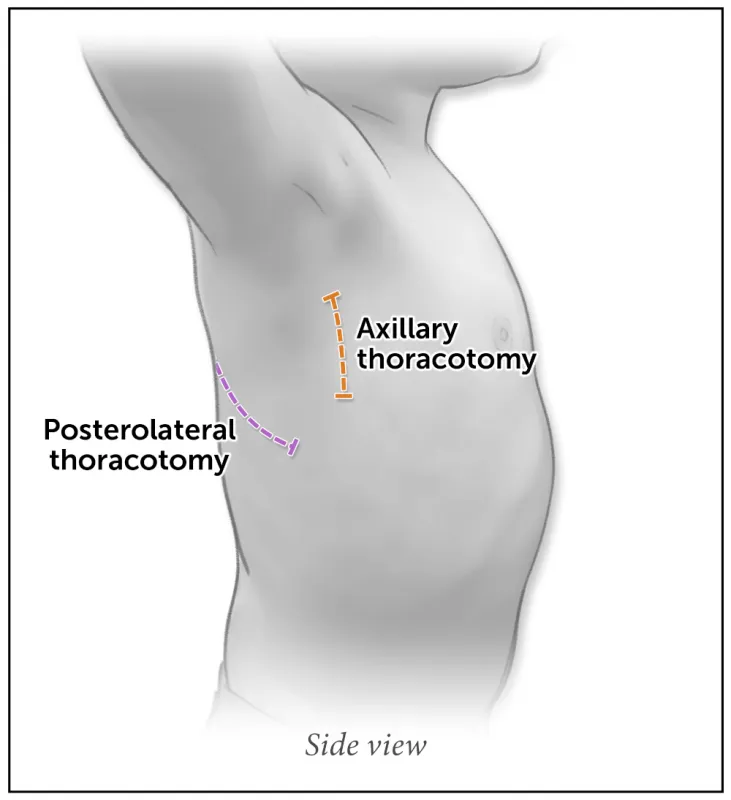
Boston Children’s is one of only a few pediatric hospitals in the United States to offer a thoracotomy. Instead of accessing the heart through the sternum, our surgeons make a smaller incision under the armpit, which results in a smaller, less visible scar. Unlike during a sternotomy, the thymus doesn’t need to be removed in a thoracotomy.

With a pediatric thoracotomy, your child will also experience less pain than they would after a sternotomy. Their recovery time in the hospital could be as short as two to three days. Because your child will be able to heal quickly, they should be able to resume physical activities and contact sports as soon as possible after surgery. 

A medical illustration of the incision spots for posterolateral and axillary thoracotomy approaches to treating heart defects.

The axillary and posterolateral are two ways to perform a minimally invasive thoracotomy and repair certain heart defects.

Mini-sternotomy

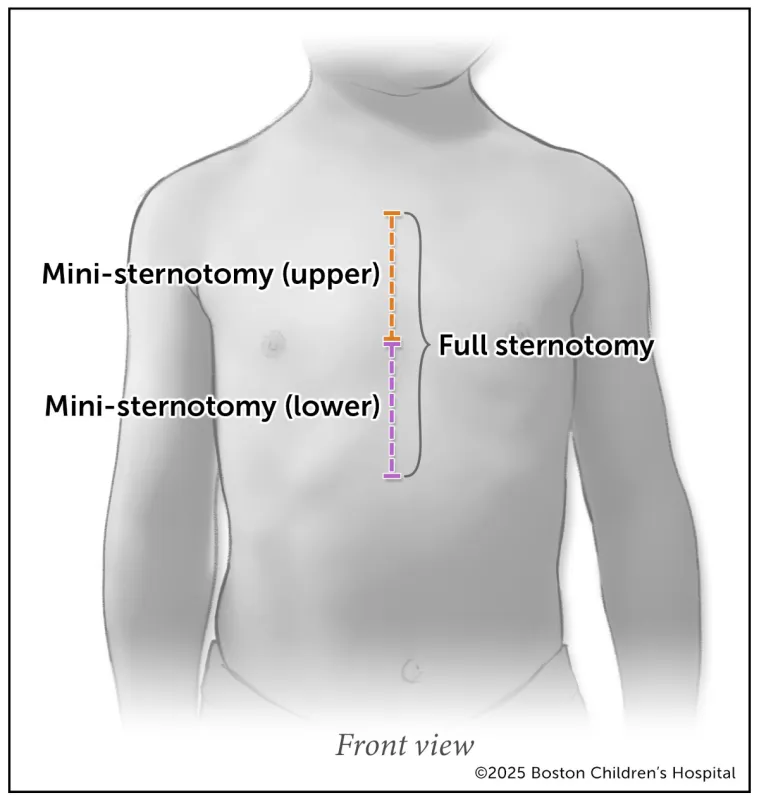
If your child is not eligible for a pediatric thoracotomy, they might be a candidate for a mini-sternotomy, which is a less-invasive approach than a full sternotomy. A mini-sternotomy requires a smaller chest incision and only a partial splitting of the sternum, either the upper or lower portion. It leaves a small incision scar on the chest and is less painful after surgery, possibly allowing your child to leave the hospital in two to three days and recover faster.

A medical illustration of the incision spots for three approaches to a sternotomy.

A mini-sternotomy on either the upper or lower half of the sternum makes a smaller surgical incision than a full sternotomy does.

Watch our webinar: Minimally invasive approach to atrial septal defect repair

Using advanced surgical techniques, Boston Children’s offers multiple treatment options for atrial septal defect, including a minimally invasive thoracotomy approach. In this webinar, we discuss what ASD is, when it can be closed in the catheterization lab, and the different surgical options available.

Which conditions are treated with minimally invasive heart surgery?

Conditions that can be treated with a thoracotomy or mini-sternotomy include:

Minimally invasive surgery for atrial septal defects

An atrial septal defect is a type of congenital heart defect in which a hole is present in the middle of the heart wall. Although atrial septal defects in children and adults have traditionally been treated with sternotomy, some patients may be eligible for minimally invasive heart surgery, such as thoracotomy and mini-sternotomy.

Which minimally invasive surgery is best for your child?

Our Cardiac Surgery team at Boston Children’s Benderson Family Heart Center will review all surgical treatment options with your family. If your child is a candidate for minimally invasive cardiac surgery, such as thoracotomy or mini-sternotomy, we will fully explain the approach we recommend and how it works. The option that is right for your child depends on their individual situation and your family’s wishes.

No matter what your decision is, your family will have all the time and resources you need to think it over. We are always available to answer any questions. Your family is an important part of your child’s care team, and you will have our full support.

Recovery from minimally invasive cardiac surgery

Children who undergo thoracotomy or mini-sternotomy tend to recover more quickly than those who undergo sternotomy. We also incorporate your child’s recovery into how we plan their pediatric thoracotomy or mini-sternotomy. That planning may include our colleagues from the Enhanced Recovery After Cardiac Surgery (or ERAS Cardiac) Program. Together, we will focus on components of care that maximize safety, minimize pain, and shorten the length of stay at the hospital. When your child goes home, our team will follow your child’s progress and heart health into adulthood.